Search This Blog

Friday, 22 March 2019

Review: Sonder Camino AL gravel & adventure bike


Sonder Camino AL

Hit the road Jack!

Spare a thought for the poor Camino. Its arrival, wagging its tail like an excited pup, coincided with a run of miserable weather! While The Beast from the East II didn’t materialise, there was no shortage of cold and drizzle.

Would the Camino shine or fade into the mist?

Sonder Camino AL review

There's only one way to test those clearances…

Overview

The Camino comes with a range of build options starting at £899. Our test bike was the ‘top dog’ Rival 1 Hydraulic build at £1399.  All builds share the same frame & fork so, whichever you opt for, you don’t need to worry you’ll miss any features of the better model. Another bonus is that Sonder build all their bikes to order. The colour options are not therefore, restricted to a single build or pricepoint. SRAM provide the 1x gearing and disc brakes fitted across the range.

Sonder Camino AL leaning against a wall

SRAM components feature on all stock Camino builds

Frame & Forks

The frame is made from double-butted 6061 Aluminium alloy, while the forks feature carbon blades and an alloy steerer. Both frame and forks have bosses for racks and mudguards, post mount brake fittings, and standard QR dropouts. So far so standard, but the Camino does a good job of hiding away some smart features. The forks might lack the increasingly popular anything cage mounts, but the frame does have three sets of bottle bosses. Home mechanics (and probably professional ones too!) will be happy to see cables running in full outers under the downtube.

Sonder Camino AL Rival

Combining a subtle paint job with minimal branding, the Camino gives off a no fuss vibe. Get in close and you’ll see the sturdy headtube backed up by a manipulated and gusseted downtube.

Sonder Camino AL welds

Moving rearwards, the chainstays use a plated design to maximise chain and tyre clearance while still staying clear of flailing heels. Alpkit rate the Camino to 40c tyres. The 37c Riddlers that came fitted to the bike, had plenty of room to spare front and back. Despite “only” having standard quick releases we didn’t experience any wheel alignment or slippage issues during the test period.

Sonder Camino AL clearance

Chainstay plate provides breathing space

Drivetrain & Braking

SRAM’s 1x groupsets are proving increasingly popular, especially with riders who spend more time off-road. Once you’re used to how it operates, Rival 1 is precise and has a positive feel. Throw in a couple of hundred kilometres of road and trail grime and it was still operating with no fuss. SRAM also seem to have exorcised the Avid ghost as the brakes are both sharp and easily modulated. Despite some pretty nasty conditions, there was no squealing and only the occasional ‘ticking’ that could be silenced with the slightest pressure on the lever.


Clutch mech keeps the chain under control

Wheels & Tyres

At virtually every price point, something has to give in order to stay under budget. Common cost savers are OEM spec tyres that usually give up grip, tubeless compatibility and lighter folding beads. Our Camino came with upgraded TCS tyres which made for a stress-free tubeless set up. While a determined rider could probably do the same with the standard tyres, it can be a hit and miss affair. We’ve ridden the Riddlers before in their 45c width and wondered if perhaps they are too much tyre. The flipside of this is that I wondered if a narrower 37c with shallower tread would be enough! Well, hats off to WTB, as the 37c Riddler makes for a great all-rounder. The tread provided piece of mind on the greasy roads and trails without proving a drag on harder surfaces. Running tubeless with between 30-50psi the Riddlers were comfy and positive. In over 600km of riding, there was no appreciable air loss and no punctures suffered. The wheels are Sonder’s own Orbit models. I’ve run a set of them for many thousands of km on my own bike without issue, and the set on our test bike have been similarly trouble free. They are stiff, stayed true and the only noise they made was the subtle buzz from from the freehub when coasting.

Fast, grippy and comfy, what more could you want?

Finishing Kit

Drivetrain, brakes and tyres aside, Alpkit/Sonder’s in house brand ‘Love Mud’ supply the remainder of the components. Naturally this keeps the cost down, but it doesn’t feel like corners have been cut. Unlike some generic components, everything was well aligned and there were no nasty rough edges. The consistent branding also gave the bike a complete look and air of quality. The Spitfire bars are a real highlight having just the right amount of drop and flare. Getting aero on the road but still being able to hustle along singletrack wasn’t an issue. The Reels bar-tape is cushioned, grippy and seems durable enough. The generous helping of stem spacers might offend some of you but it makes getting into a comfy riding position an easier task. With Sonder’s ‘build to order’ policy I’m sure you could arrange to have the steerer trimmed shorter! The Camino comes with Love Mud’s own Abode saddle. As a matter of course I usually replace the saddles on test bikes with my own favourite model. Having been comfortable on a 50km ride I decided to chance it for an all-dayer. I’m pleased to report we got on fine over 200km. As we often say, saddles are a very personal choice but at least the Abode isn’t an obvious source of discomfort like some we have encountered!

Ride & Handling

Sonder market the Camino as an endurance bike that’s suitable for “multi-day expeditions” and “Long day comfort”. That might set alarm bells ringing, but thankfully it’s not shorthand for “plodder”. For it’s first ride outing I took the Camino on the standard local test loop. Warm up with a quick tarmac blast, into a hardpack gravel blast, a quick stretch of singletrack, a spot of bog trotting and then back. Apart from the inevitable limitations of shallow tread in mud, the Camino never felt out of place. In fact, it felt so at home on the road I used it for two 200km Audax rides. Even with the Riddler tyres and 1x gearing I was barely any slower than I would have been with narrow slicks! The bike had a spritely feel, and it felt that all my power input was being transmitted into forward motion.  Sonder have done a fantastic job of balancing stability, comfort and pace. Despite the old skool QR’s the Camino tracked where you wanted it to go and we were unable to induce any brake rubbing.

Right at home on the tarmac or the dirt track

Summing up

Sonder have played a blinder with the Camino, producing a fast, fun and comfortable bike with no obvious flaws. Often we test bikes that have a but… , such as a high cost, a press fit BB or feeling weighty but not here. The Camino lives up to the ideal of an Adventure bike, a compromise of road vs trail, but without ever feeling out of its depth. Obviously we did have the advantage of TCS tyres, and I encourage purchasers to make the same upgrade for a hassle free experience. The QR axles do feel a little behind the times, but that really is just vanity. They were no detriment to the bike in practice. With its lively feel and a wide choice build options, colours and wheel/tyre choices, the Sonder merits serious consideration.

Wednesday, 13 March 2019

Visit to the Alpkit & Sonder HQ


Say hello, wave goodbye

I've had a Sonder Camino on test for over 600km. All too soon our time was up however, and we had to return it to Alpkit.  Instead of simply sending it by courier, we agreed that I would drop it off at HQ.

Nestled in a small industrial park in Nottingham, Alpkit HQ is a hive of activity. For a company that used to specialise in a few core products there is a lot going on…

I was met by Dan Thompson and Talyn Williams from the ‘Marketing and Events team’ for a quick tour. Obviously easygoing, they didn’t bat an eyelid that the Camino had plenty of evidence of its last Welsh adventure stuck to it! Having parted company with the Camino my next stop was to see Neil Sutton, the brains behind the Sonder Bikes division.

Bikes first, natch!

Sonder first hit the scene in 2015 with 5 models. An ambitious start for a new brand! In its short life, the range has more than doubled and there are currently 12 distinct models on offer. Even the original models have been revised, improved and brought up to date. Taking a break from tweaking his own personal Titanium Camino, Neil told me that there were plans for further additions to the range.

Alpkit Sonder Camino Ti

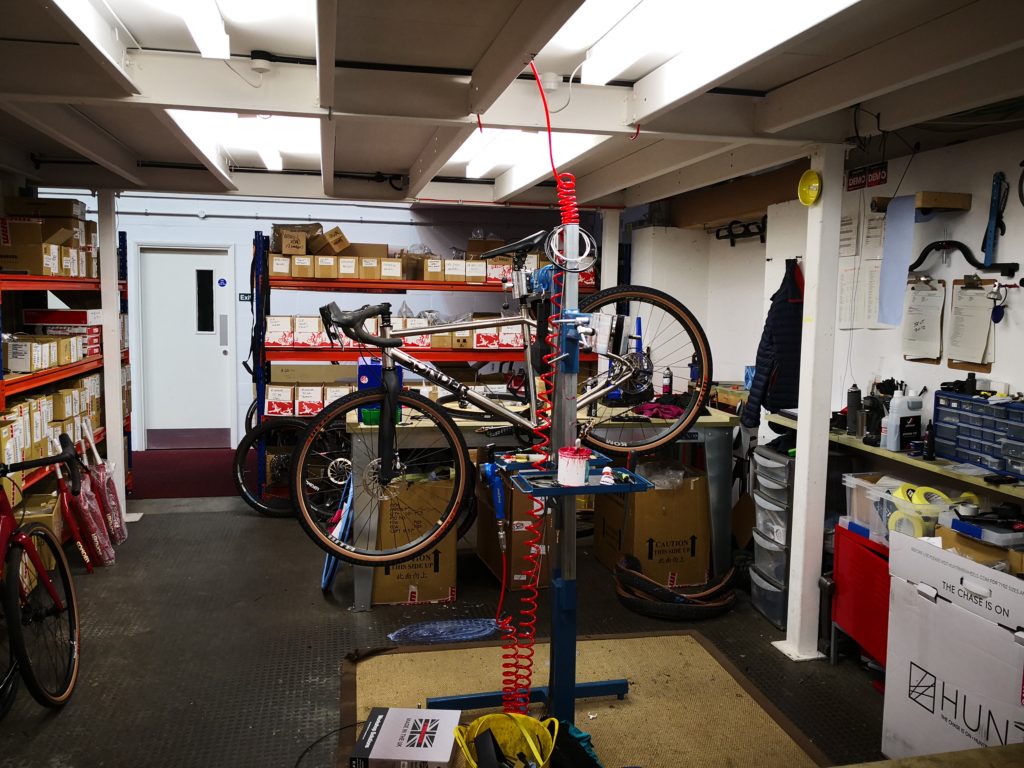
Neil Sutton’s own Titanium Camino in the Sonder Workshop

Ever expanding range

As well as the Santiago steel touring bike, the Carbon Colibri road bike will also be available in both alloy and titanium.

The Camino Al and Frontier will be equipped with thru-axles.

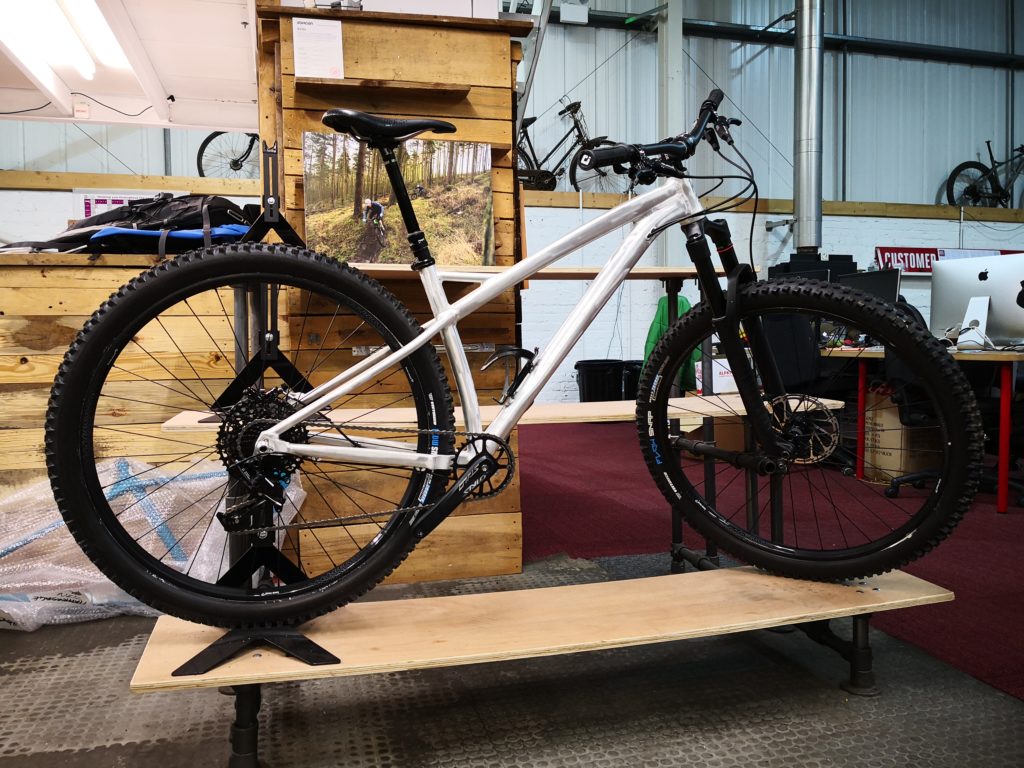
The titanium Signal trail bike will be getting an equally hard-hitting steel stable mate. The decision to go with steel soon became apparent. In the workshop was an alloy prototype based on the signal geometry. Showing that you can have too much of a good thing, Neil reveals why the alloy Signal won’t be making it into production “It’s just too stiff, it’s brutal to ride!” However fans of alloy trail bikes can console themselves with the new Transmitter, in stock and ready to go!

Alpkit Sonder Signal Prototype

Alloy Signal Prototype, redefines “hard-hitting”!

Factory custom

The eagle-eyed among you will have spotted the Hunt wheels box in the workshop photo above. This highlights one of the advantages Sonder has over its competitors. Every bike is built to order.

Neil tells me that “Customisation is no problem“

Special orders can be placed with suppliers like Hope, or customers can have components delivered to the workshop to be included in a build. Neil explained “We keep vast stocks of components and framesets on site, and customers are welcome to discuss their dream build with us. With the Ti models we can even customise the geometry.”

Just out of shot were some new tyres straight from the manufacturer and still under embargo. I’m sworn to secrecy for now but I can see them becoming very popular…

From hardware to software

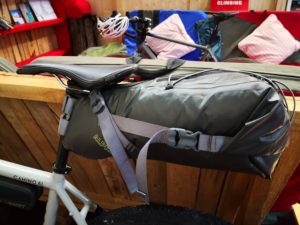
Having held up Neil for quite long enough, Dan and I continued our tour. We drop in on the staff café, not for a cuppa but to have a look at a bike just back from a test ride. The Camino propped up against the bench is fitted with the new range of fully-waterproof luggage. The specialist equipment required to weld the seams means these have to be made off-site. An additional trade-off are the limited colour and size options.

Sonder Camino ALAlpkit luggage

Made to measure

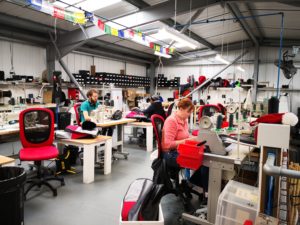
Off the shelf isn’t for everyone and here Alpkit excel. Alongside their standard range of UK made bags, they can make custom  luggage to suit your bike and your needs perfectly. This home grown range proved so popular that they quickly outgrew their original workshop. Luckily the unit next door became available and they were able to expand. Suffice to say, whatever colour scheme or feature you want, Alpkit can probably do it!

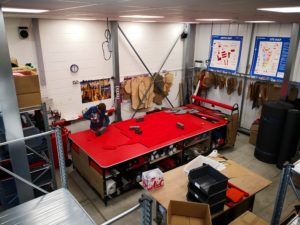
Alpkit bagsAlpkit bag test room

On leaving, I’m struck how Alpkit, an independent British company, occupies what is essentially a unique niche. By blending overseas and domestic manufacturing they bring the best of both worlds, a range that is affordable yet still bespoke. There are a number of big brands out there, that despite their resources, can’t begin to offer the same service.

For more information, head on over to the Alpkit website.

Tuesday, 26 February 2019


Time for a brew

I love a coffee and cake stop as much as the next man, but what if you are way off the beaten track? The chances are that you will be carrying a stove for those morale boosting cuppas and essential nutrition. The Alpkit BruKit could be all you need for that brew up. It is an all in one stove and pot combo that uses standard gas canisters. There are plenty of other stoves on the market but what we wanted to find out is whether this stove is one we would confidently take out on a big ride.

At first glance, the Alpkit BruKit looks remarkably similar to a Jetboil stove. As I own one of the original Jetboils, I was intrigued to see how the two compare.

Say Hey, Good Lookin’, whatcha got cookin?’

The BruKit comes complete with everything you need to get going.

There is a 1-Litre pot with inbuilt heat exchanger, neoprene pot sleeve, rubber lid and the all important gas burner. All of these come in a stuff-sac. You also get an adapter for standard cooking pans as well as a tripod that attaches to your gas cylinder.

You have to buy these last two items separately with the Jetboil, and you don’t get a stuff sac either!

Alpkit Brukit

The Brukit packs away neatly into its stuff-sac

There’s no replacement for displacement

My original Jetboil weighs 480gms, while the Brukit is 590gms. Having said that, it has twice the capacity (1 litre vs 500ml) so the weight gain is negligible. Despite the greater capacity, the Brukit is 15mm shorter and only 25mm wider than the Jetboil!

Cooking with gas

The beauty of these integrated stoves is ease of use. Screw on the gas canister, screw on the pot, fill it with water and use the integral igniter to get it going.

The BruKit pot has a built in heat-exchanger, which increases the surface area ensuring more efficient heat distribution. Consequently, you get the dual benefits of faster boiling and reduced fuel consumption. The heat-exchanger also acts as a wind-shield further preventing heat loss.

The tall pot is not ideal for cooking (as opposed to just boiling water) but the adapter makes it easy to use standard pots too.

The gas flow is easily adjusted so you can simmer rather than just go full blast!

Alpkit Brukit

The adapter included for standard pots

alpkit brukit stove in place

Standard pot in place


The need for speed

If you want a quick cuppa you won’t want to wait forever for your water to boil. Nor do you want a gas-guzzler which means you have to take spare gas on every trip.

A simple test should demonstrate the relative efficiency of each stove. So I set up a head to head.

The task was to see which stove brought 500ml of water to boiling quickest and which one used the least fuel. ( 500ml is the Jetboil’s maximum capacity and is also roughly what you need for a dehydrated meal.) To calculate which stove used the least fuel, I weighed the gas canister before and after each test.

Stove testedBoiling time for 500mlGas consumption
Standard Jetboil3 mins 10 seconds4gms
Alpkit BruKit2 mins 52 seconds3gms

As you can see the BruKit was both faster to boil and used less gas than the Jetboil!

Another advantage is that the Brukit takes a larger gas canister which can be stored in the stove during transit. If you remove the pot adapter and canister tripod, the BruKit will accommodate a 350gm canister.

With everything you need in the box (bar gas!) the BruKit is fantastic stove, fast, efficient, easy to use and lightweight. Lighter, more compact, stoves won’t be as user friendly nor will they have the same capacity. They will probably need a wind-shield too to remain efficient.

If you are riding in a group, sharing out kit, a BruKit would beat individual smaller stoves in most cases. I thoroughly recommend it!

Tuesday, 5 February 2019

Review: Backcountry Research Super-8 Top Tube Strap


Simplify, then add lightness

The Back Country Research Super-8 falls into the Now why didn’t I think of that category. The concept is delightfully simple and incredibly effective. A rubber backed wide velcro strap attaches to your top tube, and two pairs of shock cord loops with rubber tubes are used to secure items. In practice it’s child’s play to operate.

Place the Super 8 in easy grabbing distance!

Keep it simple…stupid!

Weighing in at 35g the only lighter way realistically to attach something to your bike is a couple of wraps of electrical tape! The negligible weight and bulk of the Super 8 means you won’t notice it if you leave it on the bike and switching it to another takes seconds. Constructed from a synthetic rubber called Hypalon, the Super 8 is rot and UV resistant, so when it gets grubby it’ll survive a trip through the wash.

The Super 8 has really come into its own of late. Frosty starts have necessitated big gloves and warm layers but as soon as the sun pops over the treeline you start to overheat. The Super 8 keeps these shed layers secure and to hand if conditions take a turn for the worse again. Far better than cramming jersey pockets to bursting point!

The Backcountry range doesn’t stop at the Super 8 and Keep Pedalling also supply the Mutherload, Race and Camrat straps. These are designed primarily for puncture repair kit and varying sizes of spare tube.

The Super 8 retails for £21.95 in store or can be bought online from Keep Pedalling by clicking here.


Monday, 4 February 2019

Review: Passport Cycles Lug-Kage


Passport Cycles Lug-Kages

When you come to a fork in the road, load it!

Increasing numbers of bikes are being launched with “three pack mounts”. They look like bottle cage mounts but with a third bolt and are typically found on fork blades or down by the bottom bracket. So what are they all about?

Quite simply, these mounts provide additional opportunities to hang stuff on your bike.

The Lug-Kage is Passport’s version of the “anything cage”. Essentially these are oversized bottle cages that can swallow up items larger than your regular bidon.

Passport Cycles Lug-Kage

What’s it made from?

The Lug-Kage is made of 6mm alloy rod, tig welded to a mounting plate. They are anodised to keep corrosion at bay, and are available in silver or black. The cages come with new bolts and a pair of velcro straps to hold your kit in position.

Load em up!

While this style is known as an “anything cage” there are limits. Passport rate the Lug-Kage up to 3kg and recommend using them in pairs. This is common sense really,  as hanging 3kg off one side will cause havoc with handling!

The velcro straps are long enough for anything that will fit in the cage.

The Lug-Kage is ideal for carrying lightweight but bulky items like sleeping bags, kip mats and down jackets. As a general rule of thumb, if it can fit in a 4-5 litre dry bag, you can probably carry it. It’s worth noting that the straps should compress the load directly and not around the cage itself otherwise you’ll bend it.

There are three slots in the base plate so you can adjust the strap location to suit your load. Fitting is as easy as undoing and tightening a few allen bolts. The bolt holes are slotted to allow a degree of adjustment.

Some forks (like those on the Specialized Sequoia) have two bolt mounts. These are likely to have the correct spacing but be sure to check the recommended load limits. Use isn’t restricted to fork blades, a number of bikes have suitable bosses on the downtube but then there are pedalling clearances and tyre spray to consider.


Passport Cycles Lug-Kages

On the trail

With a suitable load the Lug-Kage has minimal effect on handling. You might find the looks a little challenging but that’s a small price to pay for  increased load capacity. I found that, as the cages don’t protrude beyond the width of your bars, you don’t snag the scenery as much as you might think.

The arrival of the Lug-Kages coincided with our test of the Alpkit Brukit stove. Carrying rigid items like the Brukit in a saddle pack is rarely satisfactory as you have to pack around it to keep the pack stable. Putting it in the Lug-Kage however was a breeze, and meant the stove was easily to hand for an impromptu brew up!

Passport Cycles Lug-Kage on Surly Moonlander

Obviously if aero-gains are high on your list of priorities the Lug-Kages aren’t going to appeal, but if you want to up your load lugging capacity you can’t go wrong.